Listing of Agreement, Regulations, Rules and Convention regarding the Unitary Patent
First of all, the legal basis is given here, which is referred to in the rest of the document.
The Unitary Patent is based on several legal provisions. First of all there is the “Unitary Patent Package“:
- One part of the Package is the Regulation (EU) No 1257/2012. This Regulation implements enhanced cooperation in the area of the creation of unitary patent protection, authorised by Decision 2011/167/EU.
- A further part of the Package is the Regulation (EU) No 1260/2012. This regulation is in regard to the applicable translation arrangements.
- The agreement on a Unified Patent Court (“UPCA”) is also part of this Unitary Patent Package.
The UPCA creates a new court (Unified Patent court) and new substantive standards of patent law. The two Regulations create a Unitary Patent, namely a “European Patent with unitary effect” / “Unitary Patent”. The European Patent changes from a “bundle patent” to a (small) “unitary patent”.
Furthermore, there is a secondary legislation:
- Rules relating to Unitary Patent Protection (“UPR”).The UPR provide for the establishment of a Unitary Patent Division within the EPO and lay down the details regarding all the procedures to be conducted by the EPO.
- Rules relating to Fees for Unitary Patent Protection (“RFeesUPP”). The RFeesUPP set out the amounts of all the fees and expenses payable to the EPO by Unitary Patent proprietors and how they can be paid.
- UPC Rules of Procedure (“Rules UPC”).
Then the European Patent Convention (“EPC”) has to be considered regarding the Unitary Patent. The EPC is the Convention on the Grant of European Patents of 5 October 1973, including any subsequent amendments.
Classification of the European countries regarding the Unitary Patent
The UPCA is open to accession by any of the EU Member States of the European Union. At present, there are 27 EU Member states: Austria, Belgium, Bulgaria, Croatia, Cyprus, Czech Republic, Denmark, Estonia, Finland, France, Germany, Greece, Hungary, Ireland, Italy, Latvia, Lithuania, Luxembourg, Malta, Netherlands, Poland, Portugal, Romania, Slovakia, Slovenia, Spain, Sweden.
The UPCA is not open to states outside of the European Union, such as UK. Up to date, all EU Member States except Spain, Poland and Croatia have signed the UPCA. Therefore, 24 EU Member States have signed the UPCA, wherein these Member States are called “Contracting Member States” according to Art. 2(c) UPCA (or “Participating Member States” according to Art. 2 Regulation (EU) No 1257/2012).
The 27 EU Member States are in addition members of the European Patent Organisation. All in all there are 38 members of the European Patent Organisation e.g. including UK.
Different types of patents in Europe
In Europe there are different options for patent protection:
- “European patent with unitary effect” (also called “Unitary Patent”) means a patent granted under the provisions of the EPC which benefits from unitary effect by virtue of Regulation (EU) No 1257/2012, see Art. 2(f) UPCA. This patent benefits from unitary effect in the Participating Member States by virtue of Regulation (EU) No 1257/2012 who have already ratified the UPCA.
- Classic “European patent” means a patent granted under the provisions of the EPC, which does not benefit from unitary effect by virtue of Regulation (EU) No 1257/ 2012, see Art. 2(e) UPCA. A classic European Patent can be validated in the 38 members of the European Patent Organisation.
- Combination of a European patent with unitary effect and a classic European Patent. With a Unitary Patent combined with a classic European patent it is possible to seek a Unitary Patent and, in addition, validate the European patent in those EPC contracting states not territorially covered by the Unitary Patent scheme because the EPC contracting states are not a Contracting Member State which have signed and already ratified the UPCA or the EPC contracting states are generally not EU Member states.
- National Patent (and Utility Model if possible) in the respective European Country.
European Patents with unitary effect will have different generations in the future
The European Patent with unitary effect covers the territories of those participating Member States in which the UPCA has taken effect at the date of registration of unitary effect of a patent by the EPO.
The territorial coverage of a given generation of a European Patent with unitary effect will stay the same for its entire lifetime, irrespective of any subsequent ratifications of the UPCA after the date of registration of unitary effect. In other words, a given Unitary Patent’s territorial coverage will not be extended to other Member States which ratify the UPCA after the EPO has registered its unitary effect.
The participating Member States covered by a given Unitary Patent will be listed in the Register for Unitary Patent Protection.
The Unitary Patent architecture
Pre-grant phase (including opposition, limitation and revocation proceedings) of a Unitary Patent is based on the EPC. Therefore, the pre-grant phase for Unitary Patents is exactly the same as for classic European Patents.
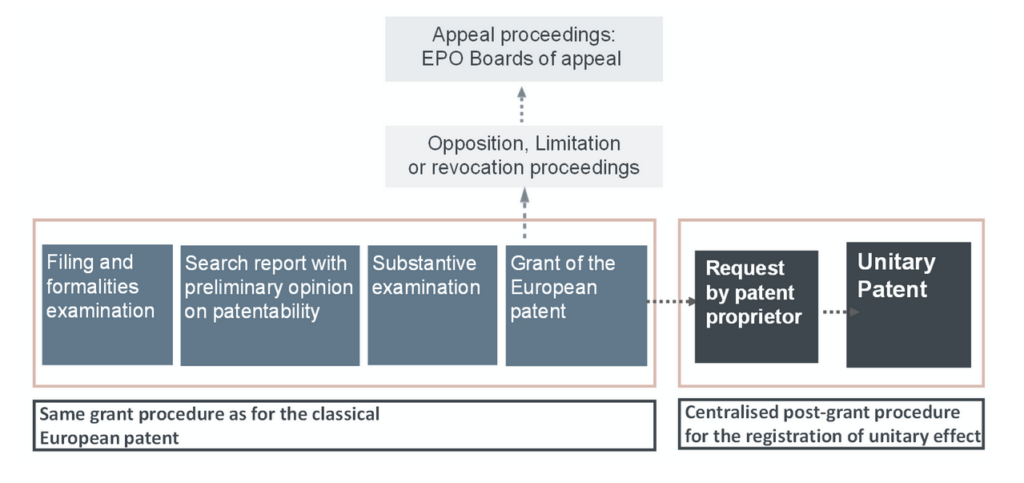
The EPO is entrusted by the participating Member States with the administration requests for a Unitary Patent (= requests for unitary effect).
Unitary Patent Division at the EPO
- A “Unitary Patent Division” has been set up at the EPO as a special department to deal with Unitary Patents.
- It is responsible for all the EPO’s additional tasks relating to Unitary Patents referred to in Article 9(1) Regulation (EU) No 1257/2012 and entrusted to it by the participating Member States under Rule 1(1) UPR.
- The EPO departments entrusted with the procedures laid down in the EPC, namely the search, examining and opposition divisions, the Legal Division and the boards of appeal, will have no responsibilities in relation to Unitary Patents.
- Actions against decisions of the Unitary Patent Division must be brought before the Unified Patent Court (see Articles 32(1)(i) and 47(7) UPCA) and not before the EPO boards of appeal.
Main features of a European Patent with unitary effect (Art. 3 Regulation (EU) No 1257/2012)
- A European patent with unitary effect shall have a unitary character. It shall provide uniform protection and shall have equal effect in all the participating Member States who have ratified the UPCA.
- A European patent with unitary effect may only be limited, transferred or revoked, or lapse, in respect of all the participating Member States who have ratified the UPCA. Dropping of individual designated contracting states as with the classic European Patent is not possible with the Unitary Patent.
- A European patent with unitary effect may be licensed in respect of the whole or part of the territories of the participating Member States who have ratified the UPCA.
- The unitary effect of a European patent shall be deemed not to have arisen to the extent that the European patent has been revoked or limited.
Requirements for obtaining a Unitary Patent
First of all, in order to be eligible for registration as a Unitary Patent, a European patent must have been granted with the same set of claims in respect of all participating Member States (Rule 5(2) UPR; Article 3(1) in conjunction with Recital 7 Regulation (EU) No 1257/2012).
Therefore, it is important not to withdraw the designation of any of the participating Member States because this would rule out obtaining a Unitary Patent.
As to the procedure for obtaining a Unitary Patent, a formal “request for unitary effect” must be filed with the EPO in writing by the European patent proprietor (Rule 5(1) UPR). This request must be filed no later than one month after the mention of the grant of the European patent is published in the European Patent Bulletin (see Rule 6(1) UPR; Article 9(1)(g) Regulation (EU) No 1257/2012; Article 97(3) EPC).
However, contrary to the normal EPC regime, where any of the three EPO official languages may be used in written proceedings (see Rule 3(1) EPC), requests for unitary effect have to be filed in the language of proceedings (see Article 9(1)(g) Regulation (EU) No 1257/2012 and Rule 6(2) UPR; see also point 58 above).
A Unitary Patent can also be requested for a European patent granted to multiple proprietors in respect of the same or different participating Member States as long as it was granted with the same set of claims in respect of all those participating Member States.
Only, however, if the request for unitary effect has been duly signed by all the proprietors (or their representative(s)) is their common representative entitled to act for them all. Multiple proprietors need not be listed in the request for unitary effect in the same order as in the request for grant (EPO Form 1001) or in the European patent specification.
Translation of the Unitary Patent
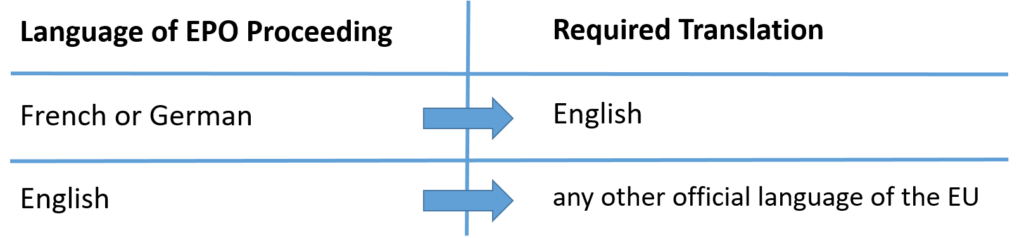
During a transitional period (see below) the request for unitary effect must also contain a translation of the European patent as required under Article 6(1) Regulation (EU) No 1260/2012, as follows:
- where the language of the proceedings is French or German, a full translation of the specification of the European patent into English; or
- where the language of the proceedings is English, a full translation of the specification of the European patent into any other official language of the European Union.
The translated text has no legal effect and is for information only.
The transitional period is at least 6 years and max. 12 years, see Art. 6 Regulation (EU) No 1260/2012. After the transitional period a translation is no longer necessary, see Art. 3(1) Regulation (EU) No 1260/2012.
Compensation for translation costs is available for small and medium-sized enterprises (SMEs), natural persons, non-profit organisations, universities and public research organisations having their residence or principal place of business in an EU Member State.
Costs of a Unitary Patent after Grant
In the pre-grant proceeding the costs for a Unitary Patent and a classic European Patent are the same. For a Unitary Patent a uniform annual renewal fee have to be paid with the EPO. According to the table below, you can see the renewal fees of the Unitary Patent after grant (as of 2022). They are compared in this table to the renewal fees of a Unitary Patent together with a national UK-Patent, a Classic European Patent validated in DE, FR, UK and a Classic European Patent validated in DE, FR, UK, IT.
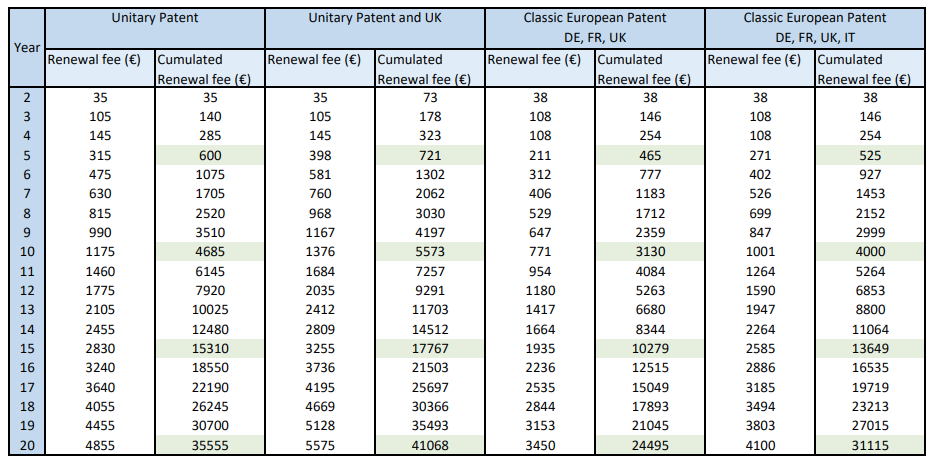
The annual fees for the first 10 years – the average life of a patent according to the EPO – would amount less than € 5000,- for a Unitary Patent. The other options are roughly similar in terms of costs in this timeframe.
The costs for a payment service provider will be less for the single renewal fee of the Unitary Patent compared to possible multiple renewal fees of a classic European Patent. Therefore, the renewal fees are competitive in this timeframe, especially if more than three countries are designated for a classic European patent.
Further, no validation costs are necessary for the Unitary Patent compared to the respective validation costs for the designated countries of the classic European Patent. For example the validation costs for DE, FR, UK of a classic European Patent are around € 150,- respectively.
Applicable law for Unitary Patents as an object of property
A European patent with unitary effect can be an object of property e. g. for licence agreements, transfer, corporate restructurings etc. Therefore, the applicable law in such cases is important.
According to Art. 7 Regulation (EU) No 1257/2012 a European patent with unitary effect as an object of property shall be treated in its entirety and in all the participating Member States as a national patent of the participating Member State in which that patent has unitary effect and in which, according to the European Patent Register:
(a) the applicant had his residence or principal place of business on the date of filing of the application for the European patent; or
(b) where point (a) does not apply, the applicant had a place of business on the date of filing of the application for the European patent.
This means, if the applicant has his principal place of business e. g. in Germany, then the European patent with unitary effect as an object of property is treated as a national German Patent and German law is applicable.
In case of several applicants – e. g. two or more persons are entered in the European Patent Register as joint applicants -, point (a) above shall apply to the joint applicant indicated first. Where this is not possible, point (a) above shall apply to the next joint applicant indicated in the order of entry. Where point (a) above does not apply to any of the joint applicants, point (b) above shall apply accordingly. For example, if the first applicant has his principal place of business in France and the second applicant in Germany, then the European patent with unitary effect as an object of property is treated as a national French Patent
Therefore, if there are joint applicants from different countries the order of the applicants in the Patent Register plays an important role. The order can be changed in the granting proceeding of the European patent application.
Where no applicant had his residence, principal place of business or place of business in a participating Member State in which the patent has unitary effect, the European patent with unitary effect as an object of property shall be treated in its entirety and in all the participating Member States as a national patent of the State where the European Patent Organisation has its headquarters in accordance with Art. 6(1) EPC, namely Munich in Germany. In other words, for applicant(s) outside the EU, German law applies for the European patent with unitary effect as an object of property. Germany is advantageous because there are comparatively few formal hurdles. For example, patents can be transferred orally in Germany.
This referral mentioned above is static and cannot be changed by transfer of ownership. Example: Patent proprietor as first applicant A based in USA transfers his European patent with unitary effect to French company B, German law remains applicable for the European patent with unitary effect as an object of property.
Conflict of the Unitary European patent with national rights of earlier date
For a European patent application that is intended to be validated as a classic European patent after grant, where a national right of an earlier date exists in a contracting state designated in this European patent application, there are several possibilities of amendment open to the applicant. First, that designation may be withdrawn from the application for the contracting state of the national right of earlier date. Second, for such state, the applicant may file claims which are different from the claims for the other designated states. Third, the applicant can limit the existing set of claims in such a manner that the national right of earlier date is no longer relevant. For a European patent application that is intended to have unitary effect after grant, only the third option is applicable. This means, an applicant for a European patent with unitary effect has to amend the set of claims of such an application accordingly.
In a possible action for revocation there is an important difference between a classic European Patent and a European Patent with unitary effect, please see the following example:
21.08.2023: DE application A filed.
29.03.2024: EP application B filed (first applicant from Berlin).
21.02.2025: DE application A (novelty-destroying for B) is disclosed.
20.03.2025: EP application B is granted.
1st possibility: The EP application is validated as a classic European Patent (EP-B) for several countries including Germany (with opt-out)
In an nullity proceeding (action for revocation) EP-B is revoked for DE only before the German Federal Patent Court, because of the national right of an earlier date in DE. In all other validated countries EP-B remains in force, because only in Germany the DE application A is opposed to a national German patent respectively to a European Patent validated in Germany. In the other validated countries the national right of an earlier date in DE is not relevant.
2cd possibility: The EP application is validated as European Patent (EP-B) with unitary effect
In an nullity proceeding (action for revocation) before the UPC the EP-B is revoked in respect of all the participating Member States who have ratified the UPCA because of the DE application A as a national right of an earlier date. This is because the first applicant is from Berlin, Germany and therefore, according to Art. 7 Regulation (EU) No 1257/2012 the EP-B shall be treated as a national German patent (please see also above under “Applicable law for Unitary Patents as an object of property”).
Advantages of the European Patent with unitary effect
- Centralised pre-grant procedure after grant and not only until grant, as in classic European patents.
- Business-friendly level of renewal fees and less complexity in paying renewal fees compared to classic European patents.
- No parallel litigation in the contracting members having already ratified the UPCA. Litigation is centralized at the UPC.
- The unitary patent provides inventors with uniform and comprehensive territorial protection in the contracting members having already ratified the UPCA.
- A validation of the Unitary Patent in several states is not necessary. The validation for a classic European Patent is a time-consuming and complex administrative process, e.g. translations have to be filed, fees charged by national patent offices and attorney fees arise. In contrast, for obtaining the Unitary Patent patent proprietors file a single request with the EPO.
- For the Unitary Patent one single renewal fee have to be paid to the EPO. The fee has to be paid in one currency and under a single legal regime as regards to deadlines and admissible means of payment. In contrast, renewal fees for the classical European Patent vary in amount, have to be paid to different national offices operating under different legal requirements.
- The renewal fee level is very attractive and business friendly. The total fees for the first ten years – which is the average lifetime of a patent – amount to less than EUR 5000. There is a 15% reduction in renewal fees for patent proprietors who file a statement on a licence of right with the EPO.
- Reduced Costs for small and medium-sized enterprise (SME) and other small entities.
- Management of a Unitary Patent, e. g. transfers, licences and other rights, no longer need to be registered country by country in the national patent register with multiple local patent attorneys. Instead, a single registration entered in the Register for Unitary Patent Protection centrally administrated by the EPO is sufficient.
- According to Rule 1(1) UPR the EPO shall be bound by decisions handed down by the UPC in actions brought under Art. 32(1)(i) UPCA.
The Structure of the UPC
The UPC is bound by EU law in the same way as any national court, Art. 1 UPCA. Therefore, the UPC shall cooperate with the Court of Justice of the European Union to ensure the correct application and uniform interpretation of Union law, as any national court, in accordance with Article 267 TFEU (TFEU = Treaty on the Functioning of the European Union) in particular, please see Art. 21 UPCA.
The UPC is competent (Art. 3 UPCA) to any:
(a) European patent with unitary effect,
(b) supplementary protection certificate issued for a product protected by a patent,
(c) Classic European patent which has not yet lapsed at the date of entry into force of the UPCA or was granted after that date, without prejudice to Art. 83 UPCA (no opt-out) and
(d) European patent application which is pending at the date of entry into force of this Agreement or which is filed after that date, without prejudice to Art. 83 UPCA (no opt-out).
The territorial scope of UPC decisions:
- European patent with unitary effect: all participating Member States in which the UPCA has taken effect at the date of registration of unitary effect of this patent by the EPO, please see Art. 5 and 18 Regulation (EU) No 1257/2012.
- Classic European patent: in all member states where this patent is in force, please see Art. 34 UPCA.
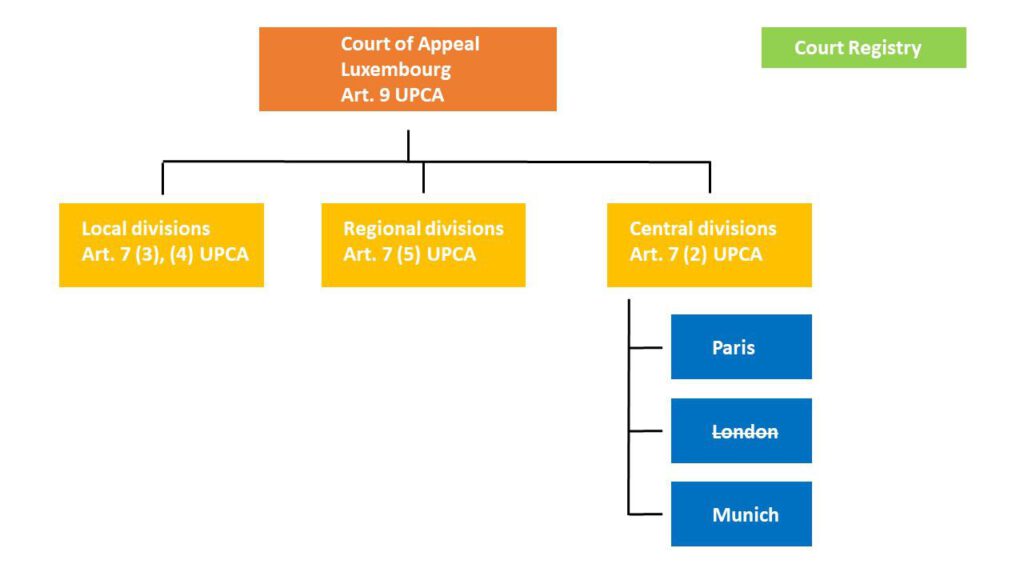
The court of 1st instance comprise a central division as well as local and regional divisions. It is competent inter alia for actions for infringement or for revocation, see Art. 32 UPCA. In general, the jurisdiction of the court depends to the defendant’s residence or place of infringement, please see Art. 33 UPCA for further information. Local divisions are for example in: Milan, Vienna, Helsinki, Paris, The Hague, Brussels, Hamburg, Mannheim, Düsseldorf, Munich.
The central divisions are competent for isolated actions for revocation (Art. 33 (4) UPCA) and for actions for declarations of non-infringement of patents and supplementary protection certificates. It also handles infringement actions if infringement takes place where no local or regional division is located or the defendant has his residence outside the territory of the Contracting Member States (Art. 33 (1) b UPCA).
The Court of Appeal in Luxembourg is competent for an appeal against a decision of the Court of First Instance, see Art. 73 UPCA.
The Court Registry is competent of the administration of proceedings and documents (all document traffic with court in electronic form), verification of formal requirements, online register of proceedings, entire procedural file accessible to anyone, restriction of disclosure only upon justified request and only to confidential information, please see Art. 22 ff UPCA.
Benefits of the UPC
- The UPC provides proprietors with a means of avoiding the high costs, risk and complexity associated with multiple litigation in different jurisdictions.
- The UPC has specialised and highly qualified judges (including technically qualified judges) will establish harmonised case law and increase legal certainty.
The transitional period regarding the competence of the UPC (Opt-out)
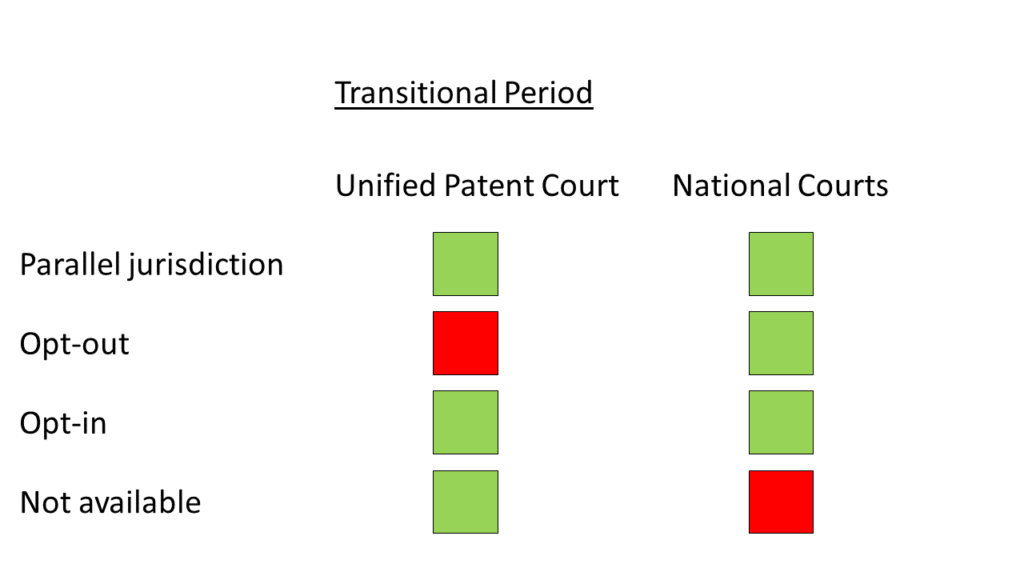
In general, the UPC is competent for European patents with unitary effect and for classic European patents. Exception: There is a seven-year transitional period, Art. 83 (1) UPCA, during which an action for infringement or for revocation of a classic European Patent can also be brought before national courts (the transitional period can be prolonged by up to seven years, see Art. 83 (5) UPCA). A proprietor of or an applicant for a classic European patent has the possibility to opt-out from the exclusive competence of the UPC, please see Art. 83 (3) UPCA. In other words, the patent proprietor of a classic European patent can exclude the parallel jurisdiction of the UPC and therefore opt for the exclusive jurisdiction of the national courts. The patent proprietor of a classic European patent cannot determine the sole jurisdiction of the UPC.
The UPC is competent for action for infringement or for revocation of European patents with unitary effect without exception. During the transitional period national courts remain competent for all proceedings concerning classic European patents. Any combination of national courts and UPC is possible.
During the transitional period for classic European Patents without opt-out, a combination of national courts and the UPC is probably possible as desired. E. g. for a classic European Patent an action for infringement could be filed with the regional court Düsseldorf (Germany) and at the UPC Regional Division Milan (Italy) for all designated countries except Germany.
Preconditions for Opt-out
A proprietor of or an applicant for a classic European patent granted or applied (not for a European patent with unitary effect) has the possibility to opt-out under the following preconditions (Art. 83(3) UPCA):
- An action has not been brought before the UPC yet. This means, that bringing a negative affirmative action for a right before the UPC renders later opt-out effectless.
- The opt-out has been notified to the Registry by the latest one month before expiry of the transitional period.
Legal issues in the context of the opt-out
The opt-out shall take effect upon its entry into the register. Thus, the application for opt-out alone is not sufficient to effectively declare an opt-out.
According to R. 5.1(b) RulesUPC, the application to opt-out has to be made in respect of all of the Contracting Member States for which the classic European patent has been granted or which have been designated in the application. Therefore, a selection decision by the patentee is not possible for opt-out.
Where the classic European patent or application is owned by two or more proprietors or applicants, all proprietors or applicants have to lodge the Application to opt-out, please see R. 5.1(a) RulesUPC. Where the person lodging an Application to opt-out is not recorded as the proprietor or applicant in the registers, the person shall lodge a declaration that he is the proprietor. In other words, all co-owners of a classic European patent or application must file the opt-out request. This could lead to disputes between co-owners. If there is a proprietor who is not listed as an applicant and who appears later, then the opt-out is only effective from the date of the opt-out request of the last “true proprietor” becomes effective.
If there is an incorrect application to opt-out, the opt-out only becomes effective with correction and from date of correction, please see R. 5.5 RulesUPC.
For a (classic) European patent application opt-out is possible. If the European patent application is granted and validated as a European patent with unitary effect, then the opt-out request is deemed to be withdrawn with effect for the territory of the European patent with unitary effect, please see R. 5.9 RulesUPC.
If a divisional application is filed based on a (classic) European patent application, then the opt-out of the European patent application does not apply to the divisional application.
Opt-in (withdrawal from the opt-out)
The opt-out can be withdrawn by means of a “Request for withdrawal from the use of the opt-out”, please see R. 5.9 and 5.9 RulesUPC. This is called “opt-in”. The possibility to opt-in is unlimited in time – i.e. even after the end of the transitional period regarding the competence of the UPC. The withdrawal from the use of opt-out can can be essentially declared according to the same formal rules compared to opt-out, i.e. in particular for each classic European patent separately and by effecting an entry in the register.
The preconditions for opt-in are:
- Opt-out has been declared previously.
- No proceeding is pending before a national court. I.e. a possible infringer, fearing an infringement action before the UPC, can file a national negative declaratory action to harm the opt-in.
- Even a completed proceeding before a national court harms the opt-in.
After the opt-in a further opt-out is not possible (no “opt-out again”).
The opt-in can only be declared for all Contracting Member States for which the classic European patent has been granted or which have been designated in the application, please see R. 5.7 RulesUPC. Hence, a selection decision by the patentee is not possible for opt-in.
Suggestions re Opt-out
- If you are an exclusive licensee with the right to sue, then a discussion with licensor should be seeked if you wish to opt-out.
- If you are a licensor you can check whether royalties are payable “as long as a contract property right is in force”. In such a case, opt-out should be considered.
- The more licence agreements exist for a European patent, the more likely it is to opt-out.
- If you are negotiating a licence agreement, please think of opt-out / validation for a European Patent with unitary effect.
- Co-owners of a classic European Patent must opt out together. Therefore, if you are one of several patent owners you should contact your co-owners.
- If you have several IP rights to “the same” invention, one European Patent should allow access to the UPC, one IP right to a national court. Therefore, if necessary, opt out of one IP right.
Approach with opt-out for “crown jewels” and “non crown jewels”
Crown jewels are:
- basic European patents with a long term,
- European patents already infringed by competitors,
- the product manufactured according to European patent is available everywhere in Europe,
- the product manufactured according to patent contributes significantly to the company’s turnover,
- the product manufactured according to patent has a high profit margin.
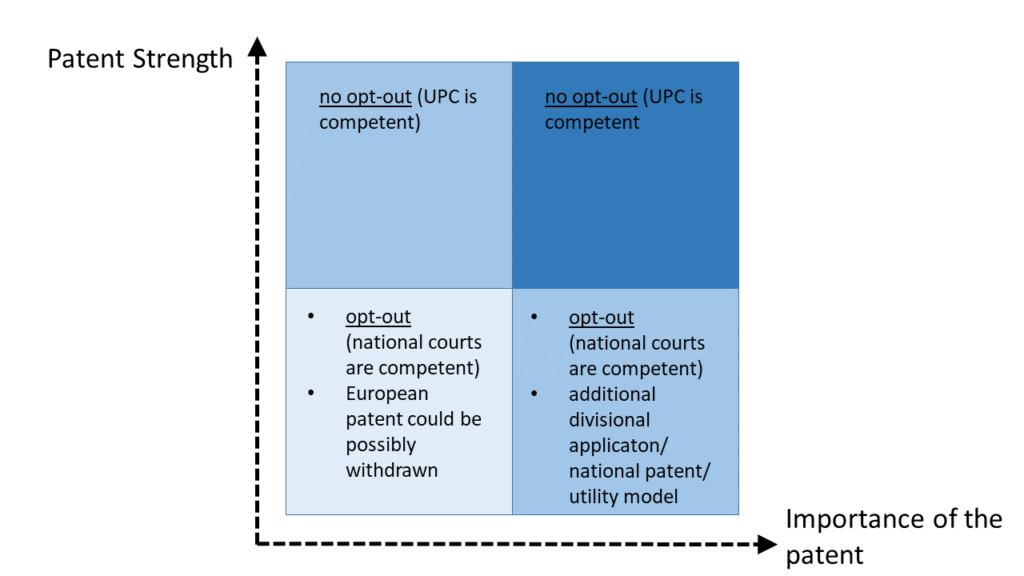
For a crown jewel opt-out is recommended to avoid a centralised revocation via the UPC.
A strong European patent (e.g. because of a successful opposition proceedings) which is not a crown jewel, access to the UPC could be maintained. Therefore, a revocation is unlikely and opt-out is rather not recommended.
For weak European patents, a request for opt-out should be filed to avoid a centralised revocation via the UPC. Afterwards, opt-in is possible (under certain circumstances, see above).
Strategic considerations on the European Patent with unitary effect
The European patent with unitary effect offers new possibilities. It offers a cost advantage compared to the classic European Patent. For example a European patent with unitary effect is useful if it protects a pharmaceutical product or if it concerns a product for a large aftermarket (for example in the automotive area). A major cost advantage exists for 6 countries or more.
With a European patent with unitary effect a central cross-border attack against infringers in one proceeding at the UPC is possible. This is also possible for classic European patents if no opt-out is requested. But in return, there is the danger of a centralised revocation via the UPC of the European patent with unitary effect or the classic European patent without opt-out.
For important inventions a strategic approach could be to file a divisional application in the examination procedure at the EPO parallel to a parent application in order to obtain a European patent with unitary effect and a (slightly modified) classic European patent (with opt-out) or the other way around. This would be lead to a strong protection, since the European patent with unitary effect has to be attacked via the UPC and the classic European patent (with opt-out) via the respective national courts. Alternatively or in addition to the divisional application, a national patent (e.g. in Germany) could have been filed parallel and/or a Utility Model can be branched off.
Prohibition of double patenting
Before the Unified Patent System Art II § 8 German International Patent Convention Act (IntPatÜbkG) stipulated that a national German patent loses its effect (ex nunc) when for the applicant or his successor a European patent with the same priority for the same invention has been granted. Therefore, a double patenting of a national German patent and a European patent having the same priority and the same invention was not possible. Since the Unified Patent System started, then a new Art. II § 8 IntPatÜbkG is applied. Accordingly, there is no longer a prohibition of double patenting for a national German patent and a European patent with unitary effect or a classic European Patent (without opt-out) having the same priority and the same invention. This is due to the fact, that the UPC is competent for this European Patents and national German courts for the national German patent. Only, if for a classic European patent opt-out is registered, then there is still a prohibition of double patenting for the national German patent and the classic European patent (with opt-out). The new Art. II § 8 IntPatÜbkG applies to all national German patents granted after entry into force of the UPCA.
Therefore, a parallel maintenance of a national German patent and a European patent with unitary effect or a classic European patent without opt-out is an option since the UPCA is into force.